Grand Avenue Field Notes
Hunting near Arco, Idaho: units, tags and the private land problem
The country around Arco looks like hunting country and mostly is, but not in the simple way a recreation map implies. South and west of town, open sagebrush and volcanic terrain run toward Craters of the Moon and the Big Desert. North, irrigation ground and foothills lead toward Moore, Mackay and the Lost River Range. Northwest, Copper Basin and the Pioneers add forest, steep canyons and high summer range. Public and private parcels interlock across all of it, game-management boundaries ignore any tidy radius around a town, and two federal reservations complicate the picture further. Hunting here is a paperwork exercise first and a physical one second, and this guide is the honest version of that.
Jump to trip essentials- Region
- Butte and Custer Counties, Idaho
- Season
- Species-specific; set annually by Idaho Fish and Game
- Category
- Hunting
Before you go
- Public and private land interlock around Arco. Get the owner’s permission before entering private land to hunt or retrieve game, and leave when the owner or agent says so.
- Tags are unit-specific: a tag or controlled-hunt permit valid in one unit may be invalid in the neighboring one.
- Sage-grouse need a separate zone tag. For 2026 Idaho issued tags across 12 zones including Craters, Lost River, Salmon-Challis and Big Desert, with areas outside defined zones closed.
- Idaho’s Motorized Hunting Rule restricts big-game hunters to roadways legally open to full-sized automobiles in designated units, currently described as August 30 through November 14.
- Craters of the Moon and the Idaho National Laboratory are separate jurisdictions; do not read hunting access off a general game-unit map.
Game unit boundaries, not a single pin
Arco, Butte County, as a base for researching regional hunting opportunities in Units 49, 50 and 51 and adjacent areas; confirm the exact destination in the Hunt Planner.
View on OpenStreetMapStart with the unit, not the scenery
Arco is a hunting base, not a single hunting unit. Regional trip planning may involve Units 49, 50 and 51, adjacent units, the Pioneer or Lemhi elk zones and controlled hunts covering only parts of a unit. A unit boundary does not establish land ownership or legal access. A zone tag may carry different dates, methods, sex restrictions and area descriptions: consult the current Idaho Fish and Game Hunt Planner and the species-specific seasons-and-rules publication for your exact hunt number before committing to a destination.
Use the Hunt Planner on the exact parcel you intend to walk before you commit a vacation to it, and print or download what you find. Cell coverage in the breaks and canyons around Arco is unreliable to nonexistent, and no map application substitutes for the current published regulation booklet for the species you are after.
What is actually here
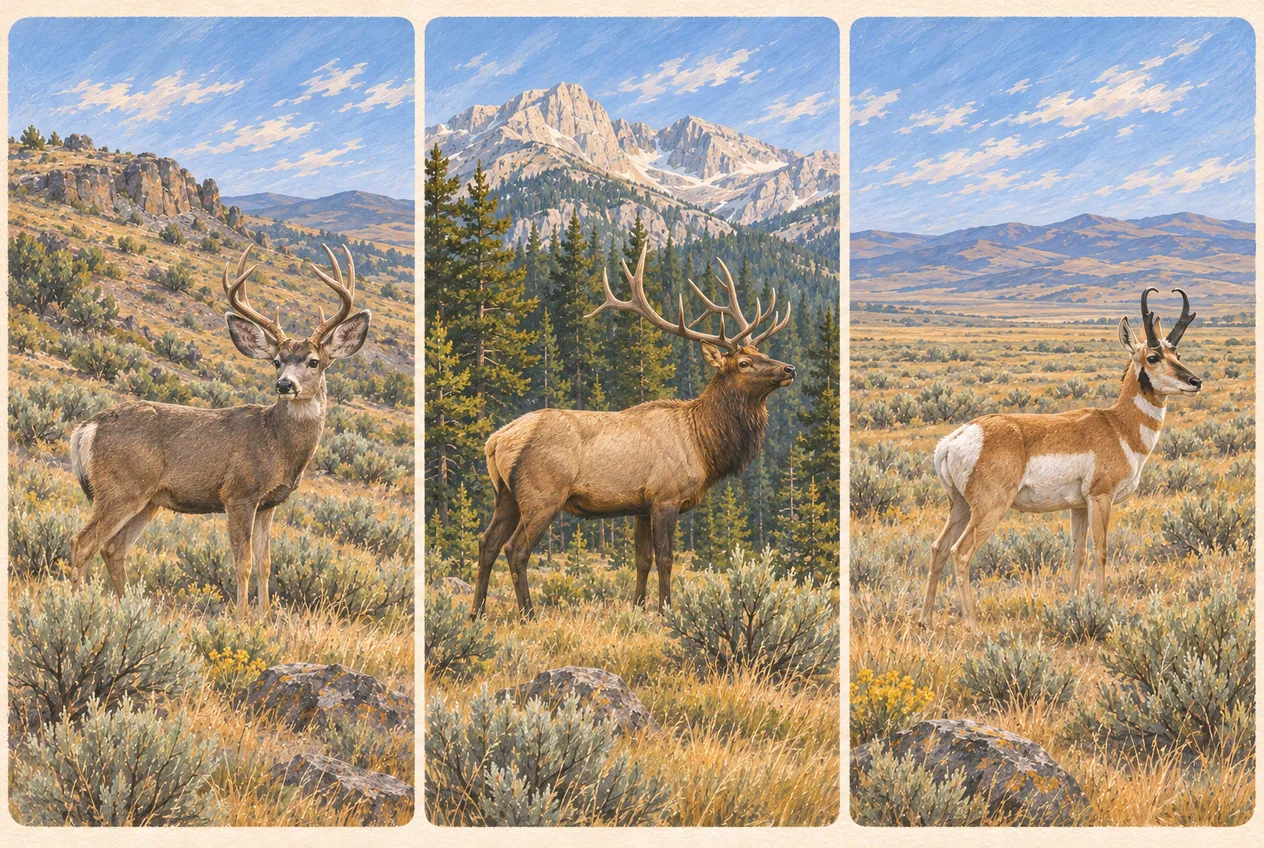
Mule deer should lead any list for this area. The habitat circling Arco, open sagebrush, foothills, canyons and mountain slopes, is exactly the mix mule deer use, and the seasonal movement between low winter range and high summer range is what makes locating them a study in land ownership as much as biology.
Pronghorn belong to the open sagebrush and high desert of the Snake River Plain and parts of the Lost River Valley. Open terrain is not the same as an unobstructed or safe firing line: pronghorn country here is crossed by roads, fences, irrigation pivot lines and the odd unmarked property corner.
Elk occupy the Pioneers, the Boulder Range and the Lost Rivers, and the practical difficulty is not the tag but the pack-out. An elk harvested high in the Lost River Range is a completely different extraction problem from a pronghorn in flat sagebrush, and the honest time to solve it is before leaving the road, with stock, a hoist plan or a legal vehicle route already arranged.
Upland birds include sage-grouse where a designated zone is open, forest grouse in suitable mountain habitat, and chukar and gray partridge where legal. Sage-grouse require a zone-specific tag in addition to a hunting license under current rules. Verify the current zone map, season and access; open-looking agricultural edges often belong to someone.
Moose, bighorn sheep and mountain goat have limited controlled opportunities in the broader region, not a general season wherever they appear. Black bear, mountain lion, gray wolf, rabbits, hares and migratory birds have separate species-specific rules and legal opportunities that vary by hunt area. Check the current publication for the species; give moose space even when you are not hunting them.
The private land reality
Do not enter private land to hunt or retrieve game without the owner’s permission. Cultivated fields, fenced parcels, ranch access roads and posted property are not public access just because they lie inside an open game unit. If an owner or authorized agent tells you to leave, leave and resolve any retrieval question through the owner or a conservation officer.
This matters more around Arco than in most of Idaho because the interlock is dense. A Forest Service road that is legal to drive can bend onto a ranch. Open fields north of town toward Moore and Mackay look public from the highway and are not. Retrieval is the case that catches people: an animal that runs 200 yards across an invisible boundary puts you on private ground with a carcass, and the answer is to call the owner or a warden, not to go get it.
Keep a public land ownership map visible in the field and mark your intended route on it. Open-country stalking on foot crosses property lines without any notice at ground level.
The Motorized Hunting Rule and ATVs
In designated Idaho units, motorized vehicle use by big-game hunters is restricted to established roadways legally open to full-sized automobiles during the rule’s applicable period; Idaho Fish and Game currently describes that statewide period as August 30 through November 14. The rule applies separately from ordinary trail designations, which produces the situation that surprises visiting riders: a route open to an ATV for recreation may be off limits to you as a big-game hunter for those weeks, and the exception for a valid Handicapped Person’s Motor Vehicle Hunting Permit is use only as the land manager allows it.
Two related points. An ATV may be ridden on routes open to that vehicle class by a hunter who is not hunting big game, under different rules, and there is a narrow exception for packing camp gear in or out where travel is otherwise permitted provided you are not hunting while doing it. None of that creates a right to drive a closed trail. The ATV guide on this site covers the route designations themselves; read the two together if you plan to ride and hunt in the same trip.
Two federal reservations that are not hunting ground
Craters of the Moon National Monument and Preserve is primarily a National Park Service visitor and preservation area. Do not decide whether hunting is allowed there from a general game-unit map; confirm agency jurisdiction and current NPS rules for the exact parcel, and expect that most of the visited area is closed.
The Idaho National Laboratory reservation is a controlled federal research environment, not open public hunting. Do not enter it to hunt, do not enter it to retrieve game, and do not use laboratory roads as a shortcut to a hunt. The EBR-I museum area being open to visitors in summer grants nothing beyond the museum.
Access, safety and the end of the day
A legal hunt here fails mostly for mundane reasons: a gate that was open last October, a road closed for a hunt or a fire, a hunter who could not get an animal out, or someone who never confirmed that a route open to motorcycles also permits the vehicle they brought. Check current notices for every land manager involved the week you travel, tell someone the boundary of your hunt, and carry the extraction plan you made.
Hunters around Arco end up in town because there is nowhere else. Club Sawtooth at 156 W Grand Ave is a reasonable place to meet a partner, check a cell signal and eat, and beer and wine are sold to go under the current license. Idaho prohibits drivers and passengers in an ordinary motor vehicle on a public highway from drinking or possessing an open container of beer, wine or liquor, with narrow exceptions, so it travels sealed. Nobody should be driving a truck onto a forest road after drinking, and during a season with early twilight a great many of these roads are shared with other hunters.
Frequently asked questions
What can you hunt near Arco?
Mule deer and pronghorn in the sagebrush and foothills, elk in the Lost River, Boulder and Pioneer ranges, and upland birds led by sage-grouse. Moose, bighorn sheep and mountain goat are controlled-permit species. Every one of these depends on your unit, tag and the current season.
Can I hunt on the public land I see from the highway?
Only if that specific parcel is public and open. Public and private ground interlock tightly around Arco, Moore and Mackay, and open fields visible from a public road are frequently private. Confirm ownership and current closures for the exact parcel before entering.
Do I need a separate tag for sage-grouse?
Yes. Sage-grouse seasons are set annually and require a hunting license plus a zone-specific tag. For 2026, Idaho issued tags across 12 zones including Craters, Lost River, Salmon-Challis and Big Desert, and areas outside the defined zones were closed.
Can I use an ATV to get to a hunting spot?
Sometimes, and not during the Motorized Hunting Rule period for big game in designated units, when a big-game hunter is limited to roadways legally open to full-sized automobiles. Idaho currently describes that period as August 30 through November 14. A route open to ATVs for recreation is not automatically legal for hunting use.
Sources and updates
Check current access, hours and conditions before setting out.