Grand Avenue Field Notes
EBR-I Atomic Museum near Arco: where nuclear electricity became real
EBR-I Atomic Museum is the rare historic site where you stand in the building where the work actually happened. On December 20, 1951, Experimental Breeder Reactor No. 1 became the first power plant to produce usable electricity through nuclear fission — the first output lit four 200-watt bulbs, and by the next day the system was generating enough power for the building itself. Visitors walk through the original control room, stand beside preserved reactor equipment and step outside to two enormous aircraft-propulsion prototypes. Two things spoil most visits before they start: arriving outside the operating season, and expecting a ticketed museum with a booking desk. EBR-I is seasonal and free, with no reservation normally required — and the second milestone people come looking for, the town of Arco being powered, belongs to a different reactor in 1955. Get both straight and the visit is one of the most underrated stops in eastern Idaho.
Jump to trip essentials- Region
- Southeast of Arco
- Season
- Memorial Day–Labor Day; verify hours
- Category
- Atomic history
Before you go
- EBR-I produced the first usable fission electricity in 1951; Arco was powered by BORAX-III in 1955 — two different milestones.
- Seasonal and free: normally Memorial Day–Labor Day, 9am–5pm daily, no reservation usually needed. Confirm the current season first.
- Allow 60–120 minutes; the key exhibits, including the original control room, are indoors.
- Museum access does not extend to the wider Idaho National Laboratory site. Stay in the public complex.
- Open high desert: carry water, bring sun protection and a light jacket, and leave Arco with adequate fuel.
Approximate landmark
Approximate EBR-I Atomic Museum complex on US-20/26 southeast of Arco; follow official highway signs and INL directions.
View on OpenStreetMapEBR-I at a glance
Full name: Experimental Breeder Reactor No. 1 Atomic Museum, also written EBR-1. Where: US Highway 20/26 between Arco and Idaho Falls, southeast of Arco; Idaho National Laboratory describes it as roughly 50 miles west of Idaho Falls. The historic milestone: first power plant to produce usable electricity through nuclear fission, on December 20, 1951, demonstrated with four 200-watt lightbulbs. Additional milestone: in 1953 testing here confirmed that a reactor could breed more fissile fuel than it consumed.
Operating life: 1951 until a final shutdown in December 1963, decommissioned in 1964, designated a National Historic Landmark in 1966. Admission: free. Tours: guided and self-guided, no reservation ordinarily required for the public tours on offer. Normal public season: Memorial Day weekend through Labor Day weekend, generally 9am–5pm daily. Current-season verification: required before you drive out. For the 2026 season INL opened the museum on May 22 and ran it daily 9am–5pm through Labor Day, with free admission, free tours and no reservations; that season also marked the 75th anniversary of the 1951 generation, so expect more programming than usual. Treat those as that season’s details, not permanent dates.
Allow 45 to 60 minutes if you only want the main exhibits and the control room, about 90 minutes for a comfortable self-guided visit, and two hours if you intend to read the panels properly, take a guided interpretation and walk around the outdoor prototypes. Do not file this away as a ten-minute roadside photo stop: the most important things are inside the building, and the story only makes sense if you let the sequence play out.
The five things you can actually see
Idaho National Laboratory describes EBR-I as the only place in America where visitors can see four nuclear reactors in one location — the original EBR-I system plus two aircraft nuclear-propulsion prototypes, with exhibits covering the later EBR-II as well. The main attractions are the original control room, the preserved reactor structure and equipment, the remote-handling devices, the radiation-detection instruments and the two prototypes outside.
The control room is where the visit lands hardest. Analog gauges, indicator lights, switches, control panels and recorder equipment are arranged the way operators worked them — no touchscreens, no high-resolution displays, just physical instrumentation, alarms and procedures managing a system nobody had built before. The reactor equipment next to it is a decommissioned historic industrial artifact, not an operating station: you are looking at how fuel, coolant and control systems were configured, in the room they were configured in.
The remote-handling equipment shows how engineers manipulated radioactive components from a safer distance, which is where a lot of the robotic-maintenance techniques now used in nuclear, aerospace, medical and hazardous-material work trace back to. The radiation-detection instruments are quietly the most useful exhibits for anyone who has always used “radiation”, “contamination” and “fission” as one vague idea — the panels separate them. And EBR-II displays connect this machine to the later reactor that ran a closed fuel cycle and demonstrated significant inherent-safety behaviour.
The four lightbulbs, and what they really proved
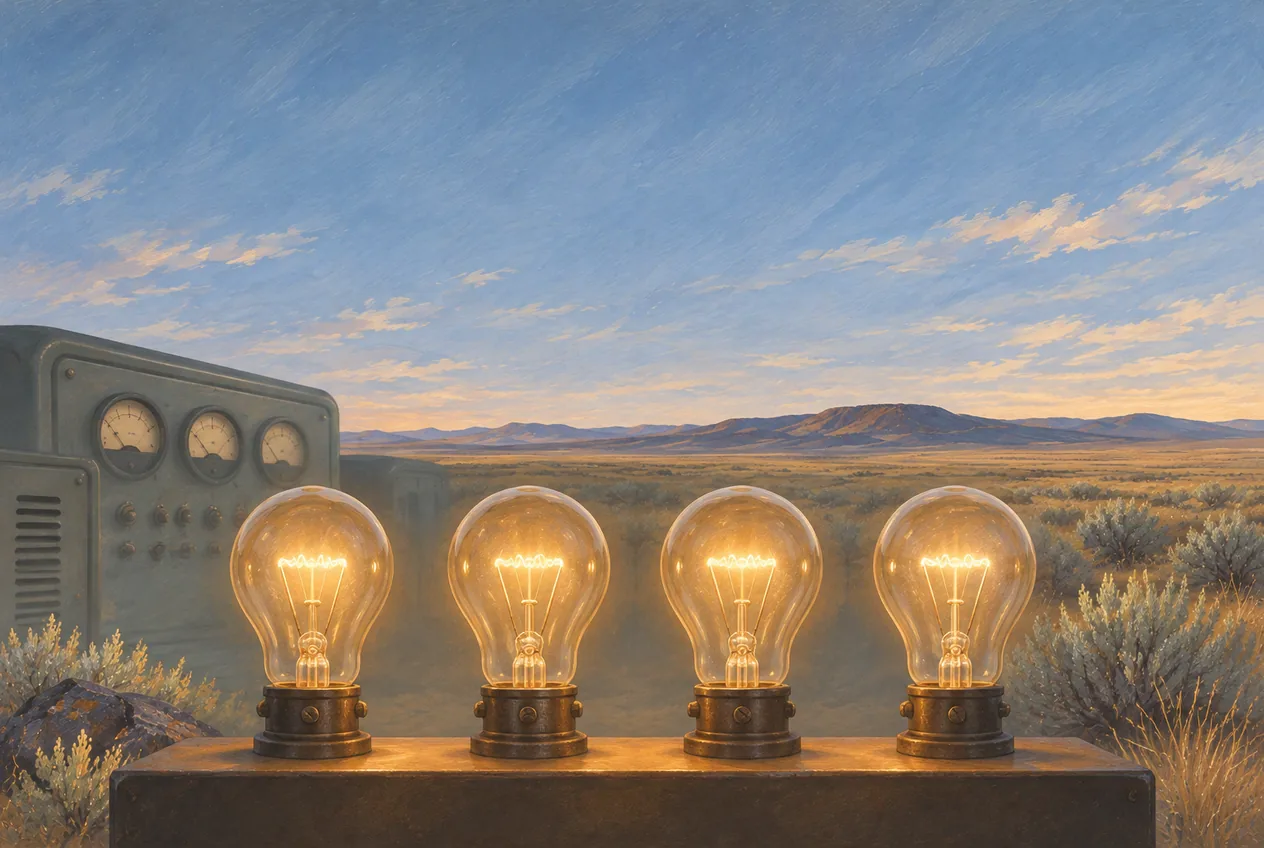
Four 200-watt bulbs total 800 watts — less than many kitchen appliances today. Their importance was never brightness. The demonstration was deliberately visible: a meter reading would have proved the same technical point, but glowing bulbs let every engineer in the room see the result at once, and turned an abstract chain of neutron physics, reactor heat, coolant circulation, turbine operation and electrical generation into a single legible image.
A logbook entry from that day records “Electricity flows from atomic energy. Rough estimate indicates 45 kW.” INL’s historical record puts the estimated output at about 45 kilowatts, and the next day the reactor-generator system supplied enough electricity to power the building. Read that carefully: the four bulbs were the ceremonial demonstration load, not the limit of the plant. What was demonstrated was the whole conversion chain working end to end — fission released heat, a liquid-metal coolant carried it, the thermal system produced mechanical energy, a generator turned that into electricity, and the electricity ran real equipment.
Was EBR-I the world’s first nuclear power plant?
The Department of Energy and INL describe EBR-I as the first power plant to produce usable electricity through atomic fission. Precision helps rather than hurts, because several genuine “firsts” get collapsed into one claim. Chicago Pile-1 in 1942 achieved the first controlled, self-sustaining chain reaction — it proved a reaction could be created and controlled, but generated no usable power. The Obninsk APS-1 in 1954 supplied roughly five megawatts to the Soviet grid. BORAX-III in 1955 produced enough electricity to power Arco. Shippingport in 1957 was the first full-scale US commercial nuclear power station.
Those milestones do not contradict each other; they answer different questions. EBR-I’s recognised achievement is the first production of usable electrical power from nuclear fission, and modern commercial plants — far larger, differently designed — descend from that practical transition from fission heat to electrical output.
What “Experimental Breeder Reactor” means
The name is a specification, not a marketing label. Experimental, because EBR-I was built to test reactor physics, materials, coolant behaviour, fuel performance and electrical generation — it was never intended as a power station serving a population. Reactor, because it sustained a controlled fission chain reaction, removed the heat and shut down through designed systems; nothing about the name means weapons work or detonations happened in that building.
Breeder is the interesting part. When a fissile atom splits it releases energy, fission products and extra neutrons. Some neutrons keep the chain reaction going; others can be absorbed by fertile material and turn it into new fissile fuel. A breeder is designed to do that on purpose, and EBR-I existed to find out whether a reactor could create more usable nuclear fuel than it consumed. The 1953 testing answered yes — which addressed one of the founding anxieties about nuclear power, how efficiently a limited fuel supply could be used.
How the machine worked, in five steps
EBR-I was a fast reactor cooled by a liquid sodium-potassium alloy, commonly called NaK. The energy path is easy to follow once you are standing next to the hardware. Neutrons struck fissile atoms in the fuel, some atoms split, and energy plus more neutrons came out. A share of those neutrons caused further fissions while control systems managed the rate. The liquid-metal coolant circulated through the core and carried heat away — liquid metals move heat efficiently and can run hot without the extreme pressure water needs at comparable temperatures. That thermal energy drove equipment turning a generator. The generator converted rotation into electricity, first proven through four bulbs and then by running the facility.
You do not need a reactor-engineering background to follow the exhibits. The value of the preserved building is that most stages of that conversion are physically present instead of drawn on a diagram, which is exactly why engineers and physics students get more out of this stop than they expect to.
Arco was powered by BORAX-III, not EBR-I
This is the mistake to avoid, and correcting it makes Arco’s story better rather than smaller. On July 17, 1955, BORAX-III — a boiling-water reactor at the then National Reactor Testing Station — produced enough electricity to serve Arco, establishing the town’s widely recognised place as the first community powered by nuclear-generated electricity. EBR-I’s own milestone came four years earlier, in 1951, and was something else entirely.
The honest timeline runs: December 20, 1951, EBR-I produces the first usable fission electricity; December 21, 1951, it powers its own building; 1953, EBR-I confirms breeding; 1955, BORAX-III supplies Arco; December 1963, EBR-I shuts down for good; 1964, decommissioned; 1966, National Historic Landmark. The region hosted a run of first-of-a-kind reactor experiments, not one lucky demonstration — and Idaho’s share of nuclear history is bigger for the distinction being kept straight. Guides and plaques in town cover the BORAX-III milestone separately from this museum.
Why eastern Idaho became the test site
The National Reactor Testing Station was established in 1949 on a large federal reservation in eastern Idaho, which later became Idaho National Laboratory. The desert site offered space to separate experimental facilities safely, relative isolation, groundwater, room for first-of-a-kind reactors, and nearby towns able to support a growing technical workforce. The laboratory site covers roughly 890 square miles.
Historic DOE information records 52 reactors built and operated there, many first-of-a-kind; current INL historical material references 55, reflecting different ways of counting facilities and reactor systems over the decades. The safest way to say it is that more than 50 reactors have been built and operated across the site since 1949. EBR-I is simply the one you can walk into.
A museum inside an active laboratory
EBR-I sits within the historical geography of Idaho National Laboratory, and this is where careless visitors cause themselves real trouble. The museum is a designated public site. A museum visit does not include, authorise or imply a tour of the rest of the laboratory. Other INL facilities involve controlled access, identification and badging requirements, advance authorisation, or no public access at all.
Do not follow unmarked or employee roads in, do not enter restricted facilities, do not photograph where signs prohibit it, do not cross security barriers, do not launch a drone over federal laboratory property, and never take a GPS shortcut through a controlled area — a generic “Idaho National Laboratory” destination in a navigation app can pull you far from the museum. Our map pin marks the museum complex approximately and grants nothing else. INL’s general guidance requires REAL ID-compliant identification for access and badging at controlled laboratory facilities, and non-US citizens may face Department of Energy foreign-visit requirements for restricted access; those rules belong to controlled facilities and should not be assumed for an ordinary museum visit unless current EBR-I instructions say so. If your plan includes a separate INL tour, follow the identification requirements issued for that tour.
Inside the museum, the boundaries are just as real: stay on the public route, follow guide instructions, respect barriers, keep children close around historic equipment, leave controls alone unless an exhibit invites you to touch them, keep food and drink away from artifacts, and remain within the complex. The desert around you looks empty and is not: it is a working federal research environment with security, environmental and safety controls. Do not go looking for active reactors, restricted areas or former test facilities on your own.
What to bring, and the identification question
The setting is open high desert: wind, sun and temperature swings are substantial even though much of the visit is indoors. Bring drinking water, sun protection, a light jacket, closed-toe shoes, a camera or phone, and questions for the guides — the staff answering them are the reason a guided tour beats reading alone. Collectors should bring a National Parks Passport booklet. INL announced a penny press and a passport stamp for the 2026 season; amenities like those can change, so do not count on them.
Fuel and water planning matter more than people expect out here. Leave Arco with an adequate fuel supply and more water than seems necessary, and do not assume services at the site. Photography is generally part of the normal museum experience, but follow every posted restriction: no shooting beyond marked public areas, no photographing security infrastructure where prohibited, never cross a barrier for a better frame, never touch or reposition artifacts, and ask staff before setting up tripods, lighting or anything commercial.
Getting there from Arco, and pairing it with Craters
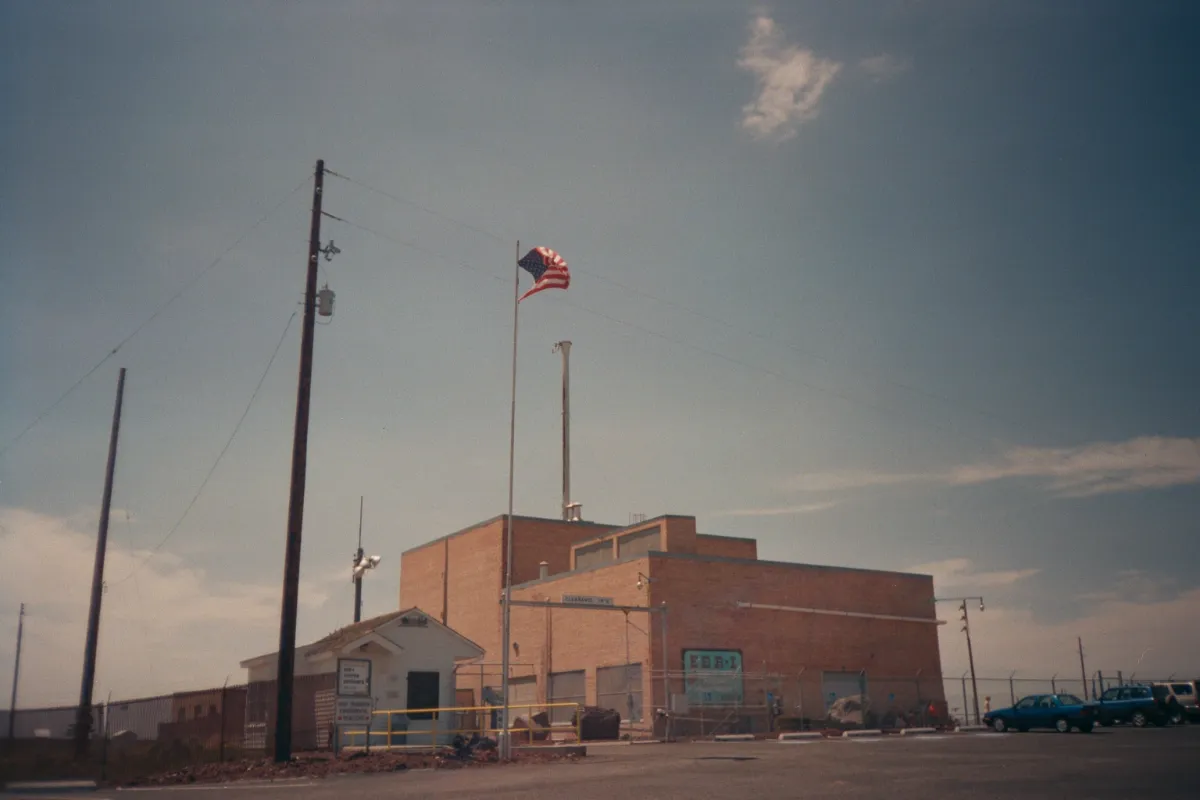
EBR-I is on US-20/26 southeast of Arco toward Idaho Falls. Follow official highway signs and current INL directions rather than navigating to an approximate pin somewhere on the reservation. The museum and Craters of the Moon are both “the Arco attraction” in travel writing and are in opposite directions: EBR-I southeast on US-20/26 toward Idaho Falls, Craters southwest on US-20/26/93. Plan them as two separate legs from Arco, not neighbouring stops sharing a parking lot.
One day can hold both, but only with an early start and a trimmed scope: EBR-I when it opens, roughly 90 minutes, back toward Arco for food or fuel, then southwest to Craters for the visitor center, Loop Road and two or three short trails, back before dark. Do not attempt the full museum plus long trails plus lava-tube caves plus stargazing in one day without accounting for daylight, visitor-center hours and cave permits — those have to be obtained in person at the visitor center during its hours when caves are open, which should decide your order if caving is the priority.

Two ways to build the day
A half day is enough for most visitors. Confirm the current operating schedule before leaving, drive southeast on US-20/26 with water and fuel, allow 60 to 120 minutes at the museum, walk around the outdoor prototypes, return to Arco, see Number Hill from a safe public place in town, eat, then finish the evening at Club Sawtooth once the vehicle is parked. Nothing in that plan is rushed and nothing depends on guesswork.
An atomic-history day runs deeper: start at EBR-I during operating hours and let the exhibits carry you from the 1951 milestone through breeder-reactor development, learn how EBR-II extended the region’s research, return to town, then treat BORAX-III as its own milestone and Number Hill as a separate community timeline — Number Hill records generations of graduating classes from the class of 1920 onward, a different kind of landmark entirely. Read together: Number Hill is community continuity, EBR-I is scientific transformation, BORAX-III is Arco’s place in public nuclear-energy history.
Off-season, closures and the virtual options
The physical museum is generally closed outside its Memorial Day to Labor Day season, and a winter road trip through Arco needs a different stop. That does not mean the history is unavailable. INL offers an EBR-I virtual tour, requests for online guided tours, an INL history virtual tour, a “52 Reactors” virtual tour, Nuclear 101 educational material, and a TravelStorys audio experience with location-triggered narration along US-20 — download that content before you are relying on patchy rural signal.
Accessibility questions are worth a phone call before the drive rather than an assumption from photographs: the museum occupies a preserved industrial facility, and even where the public route is accessible, historic equipment, doorways, floor transitions and operational layouts differ from a modern purpose-built museum. Contact INL Tours on 208-526-0050 or tours@inl.gov about mobility, hearing, vision or restroom access, and about large groups or school visits, which should be arranged in advance rather than assumed.
The harder questions: meltdown, radioactivity and safety
EBR-I did experience an unexpected partial core meltdown during a coolant-flow experiment. DOE explains that it happened during testing and contributed to understanding how reactor materials behave thermally. It should neither be sensationalised nor quietly dropped: EBR-I was an experimental reactor, the testing existed to expose how designs behaved under conditions engineers needed to know about, and the event became engineering knowledge that fed later reactor development. Three facts stay separate — the event occurred, the facility had been built as experimental research apparatus, and it does not mean the museum today runs a damaged active reactor. Reactor research has been conducted openly in this desert since 1949 and the public is welcome at historic facilities like this one.
On radioactivity: EBR-I is a decommissioned historic reactor preserved and operated as a public museum. The reactor no longer operates, and public access is managed by DOE and INL along an established museum route. Keep to the barriers and posted instructions, and do not touch internal components, open secured equipment or cross restricted boundaries. Anyone with specific concerns is better served by that framing than by absolute claims that nothing anywhere is radioactive, which no general visitor page supports.
Why engineers should not skip it
Most science museums interpret technology through replicas, video and equipment lifted out of its context. EBR-I is the exception: the reactor, control room and major systems sit where the engineers worked, so the relationships between reactor physics, heat transfer, liquid-metal cooling, electrical generation, instrumentation, remote material handling, radiation monitoring, fuel-cycle research and early safety engineering are all visible in one place. For engineers the value is the integration — this was never only a physics experiment and never only a generator, it was a complete experimental energy system.
The building earned its recognitions for that reason, not for one photogenic moment: National Historic Landmark in 1966, National Historic Mechanical Engineering Landmark and a Historic Landmark for Advances in Materials Technology in 1979, Nuclear Historic Landmark in 1987, an IEEE Milestone in 2004. For everyone else, the four-bulb story is the front door into that larger system, and standing in the control room is what makes it stick.
Finish the history trip in Arco
Back in town, Number Hill’s painted graduation years give you a very different local timeline, and the BORAX-III story gives the town its own milestone rather than borrowing EBR-I’s. Then park for the evening: Club Sawtooth at 156 W Grand Ave is a bar and gathering place — drinks, pool tables, four electronic dartboards with Remote Play, foosball, an AMI jukebox, a Mortal Kombat 4 cabinet, occasional karaoke or live music — open daily 2pm to 2am, phone (208) 527-3003.
It is worth saying plainly that Club Sawtooth has no connection to Idaho National Laboratory and is not a museum partner; it is where the drive and the conversation end. The order matters: complete the museum visit, finish the highway drive, park the vehicle, and only then order the drink. Eight hundred watts of ceremonial lightbulbs, forty-five kilowatts of actual output, and a town that got its current from a different reactor four years later is a lot to untangle over darts — which is a good place to do it.
Frequently asked questions
What does EBR-I stand for?
Experimental Breeder Reactor No. 1 — an experimental fast reactor built to demonstrate electrical generation and the breeding of new nuclear fuel. You will also see it written EBR-1.
Where is EBR-I Atomic Museum?
On US Highway 20/26 between Arco and Idaho Falls, southeast of Arco. INL describes it as approximately 50 miles west of Idaho Falls. It is a separate drive from Craters of the Moon, which lies southwest of Arco on US-20/26/93.
What happened at EBR-I on December 20, 1951?
It became the first power plant to produce usable electricity through nuclear fission. The initial public demonstration lit four 200-watt bulbs; logbook estimates put output near 45 kilowatts, and the next day the system generated enough power for the building.
Did EBR-I power the city of Arco?
No. BORAX-III, a separate boiling-water reactor, produced enough electricity to supply Arco on July 17, 1955, which is why Arco is recognised as the first town powered by nuclear-generated electricity. EBR-I’s 1951 milestone was the first usable fission electricity, a different achievement.
When is EBR-I open, and does it cost anything?
Normally Memorial Day weekend through Labor Day weekend, daily 9am–5pm, with free admission and free guided and self-guided tours. For 2026, INL listed the season as May 22 through Labor Day. Confirm the current schedule before travelling — the museum is seasonal and can close outside it.
Do I need a reservation or a permit?
INL states reservations are not required for the normal guided and self-guided museum tours during the season. Large groups, school visits and organisations should contact INL Tours in advance on 208-526-0050 or tours@inl.gov rather than assuming an unscheduled group can be accommodated.
How long should I allow for the visit?
Forty-five to sixty minutes covers the main exhibits and control room, about 90 minutes makes a comfortable self-guided visit, and two hours suits detailed reading, a guided interpretation and the outdoor prototypes. It is not a ten-minute photo stop — the important artifacts are indoors.
What can you actually see inside?
The original control room with its analog instrumentation, preserved reactor equipment, remote-handling devices, radiation-detection instruments and EBR-II exhibits, plus two aircraft nuclear-propulsion prototypes outside. INL describes it as the only place in America where visitors can see four nuclear reactors in one location.
Is EBR-I safe to visit, and is it still radioactive?
It is a decommissioned reactor preserved as a public museum, and the reactor no longer operates. Visitors must stay within designated areas and follow posted instructions; do not touch internal components or cross barriers. An experimental partial core meltdown occurred during testing in its operating years, which produced engineering knowledge rather than meaning a damaged reactor is running today.
Can I tour the rest of Idaho National Laboratory?
Not through an ordinary EBR-I museum visit. Other INL tours and controlled facilities have separate scheduling, identification, badging and access requirements. Stay inside the public museum complex, obey signs and barriers, and keep off unmarked roads and drone-free laboratory property.
Can I visit EBR-I and Craters of the Moon on the same day?
Yes, during the summer season, with an early start: EBR-I at opening, around 90 minutes, lunch or fuel in Arco, then southwest to Craters for the visitor center, Loop Road and a couple of short trails. Cave permits must be obtained in person at the visitor center during its hours when caves are open, so settle that first if caving matters.
What can I do in the off-season?
The building is generally closed outside the summer season. INL offers an EBR-I virtual tour, online guided-tour requests, an INL history tour, a “52 Reactors” tour, Nuclear 101 material and a TravelStorys audio experience along US-20 — download it before you need rural signal.
Sources and updates
Check current access, hours and conditions before setting out.