Grand Avenue Field Notes
Camping near Arco: RV parks, lava-field sites and Lost River Valley campgrounds
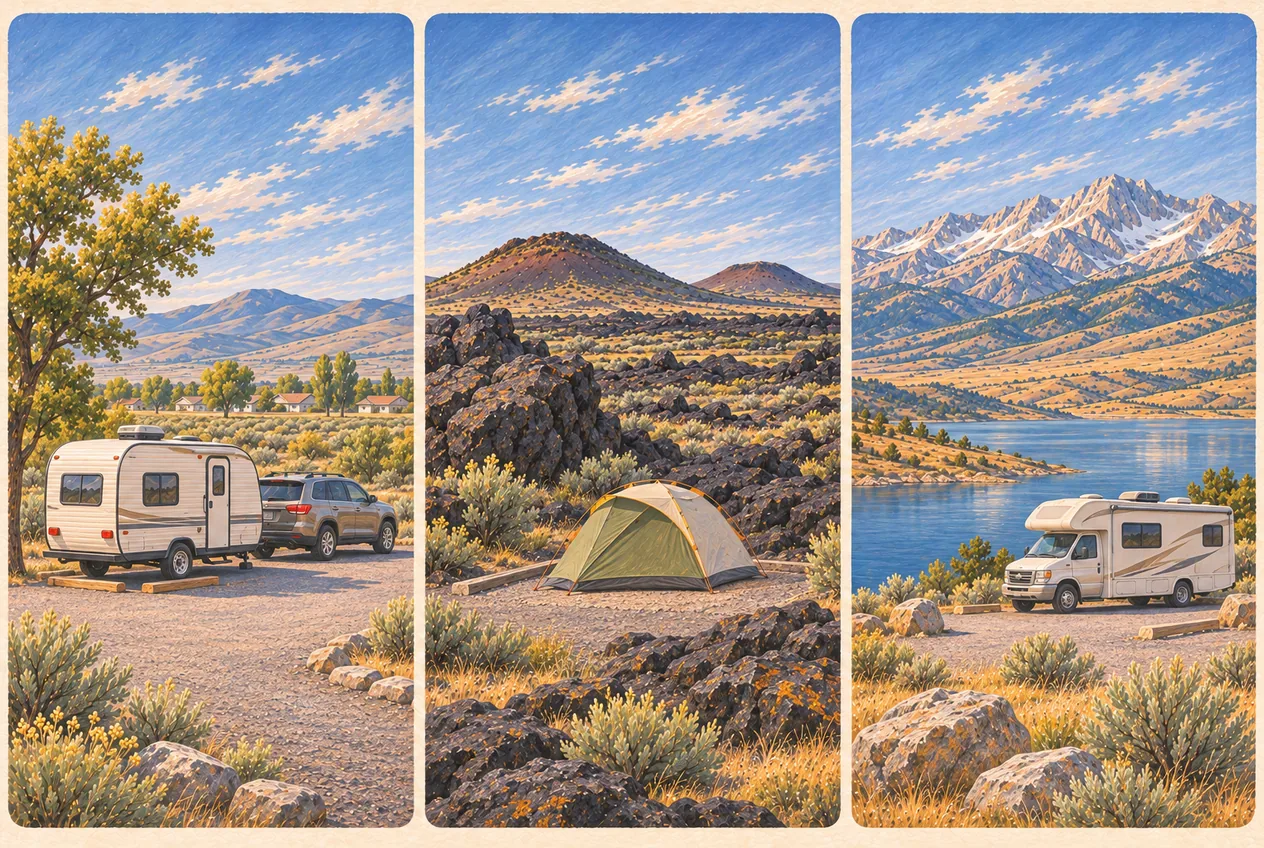
Arco works as a camping base because it sits at the junction of several very different trips: the main entrance to Craters of the Moon is about 18 miles southwest on US-20/26/93, the Lost River Valley and Mackay Reservoir lie about 30 miles north on US-93, and the Copper Basin campgrounds sit on gravel roads off that same valley. What the options have in common is less than the differences. A full-hookup pull-through in town, a free donation-based rough camp on private ground, a first-come site among 2,000-year-old lava with no water after the season shuts down, and an eight-site Forest Service clearing reached by 20 miles of washboard are all "camping near Arco," and choosing between them on distance alone is how people end up unhappy.
Jump to trip essentials- Region
- Arco, Craters of the Moon, Mackay Reservoir and the Copper Basin district of the Salmon-Challis National Forest
- Season
- Most sites run late May or June through September or early October; Arco RV parks and Joe T. Fallini operate into the colder months
- Category
- Camping and RV travel
Before you go
- In town: Mountain View RV Park (705 W Grand Ave) and the Craters of the Moon RV Park (2424 N 3000 W) are the conventional full-hookup options, and both put you a short drive from downtown Arco.
- Honeys Park (2436 N 3000 W) is privately owned rough camping commonly offered free, not a city park. Current listings describe controlled gate access, check-in with the owner and no new arrivals after sunset.
- Lava Flow Campground inside Craters of the Moon has 42 first-come, first-served sites, no hookups, no showers and no dump station, with seasonal water; check the current NPS page for the nightly fee and pass discounts.
- Joe T. Fallini on Mackay Reservoir is the BLM’s only Challis Field Office site with full RV hookups: 26 sites, a dump station and published fees from $6 for a tent site to $14 for water and electric, with a 14-day stay limit.
- The Salmon-Challis campgrounds are small and dry: Iron Bog 21 sites with a 35-foot vehicle limit, Star Hope 21, Wildhorse 13, Broad Canyon 8 and Lake Creek 4, mostly $5 to $10 a night, none reservable, water only from summer hand pumps at three of them.
- Mount Borah Trailhead has five primitive sites and no drinking water, for climbers staging a pre-dawn start, not for a recreational weekend.
No public destination pin
Arco, Idaho, with campgrounds spread along US-20/26/93, US-93 north to Mackay Reservoir and the Copper Basin Loop Road.
Pick the base camp before you pick the campground
Four camping experiences sit within an hour of Arco, and they are not variations on one theme. Town camping in Arco buys you hookups, showers, laundry, fuel, groceries, Number Hill, the EBR-I museum and a short highway drive to Craters, at the cost of any sense of isolation. Camping inside Craters of the Moon buys you the lava field at dawn and dusk with no commute, at the cost of hookups, showers, a dump station and any cell service worth counting on. The Lost River Valley, anchored by Joe T. Fallini on Mackay Reservoir, buys you public hookups, a dump station, fishing and boating and Lost River Range views. Copper Basin and Iron Bog buy you quiet, forest, trailheads and OHV routes, at the cost of gravel roads, water you carry in and no fallback if you arrive at 6 p.m. and the road turns out to be rough.
Before comparing fees, compare the things that actually decide a trip: whether you need hookups, your complete rig length and height, whether you can stand no potable water, how you will dump tanks, whether the approach is paved, whether shade exists, what the pet and quiet-hour rules are, current fire restrictions, and whether anyone in the group plans to drink and how they intend to get back. A five-dollar site that costs two hours of gravel driving and a full water haul is not a cheap site.
Everything in this guide about sites, fees and seasons is what the managing agency or operator currently publishes. Campground water gets shut off for the season on short notice, fees go up, road dates move with snow. Check the linked agency or operator page for the specific campground you intend to use, the week you intend to use it.
Camping in Arco: Mountain View, the Craters RV Park and Honeys Park
Mountain View RV Park at 705 W Grand Ave is the in-town full-hookup option. Its current listings describe pull-through sites with full hookups in 30-amp and 30/50-amp service, short-term and long-term stays, picnic tables and grills, guest laundry and showers, a large dog park, EV charging, and tent and camper-van sites with water. For a big rig, for a longer stay, or for anyone who wants a shower and a washing machine between day trips, this is the practical choice.
The property at 2424 N 3000 W has been marketed as the Craters of the Moon / Arco KOA and is currently listed as the Craters of the Moon RV Park. Franchise branding changes hands in this industry, so book under whatever name its own current booking page shows rather than under an old KOA listing you found in a forum. Public listings have reported roughly 51 sites including a handful of tent-only sites, mostly pull-throughs with a good number of full hookups, RV lengths to about 80 feet, plus showers, laundry, a dog area and seasonal extras such as a pool. Inventory moves; confirm directly. One local caution worth heeding: use the campground’s own directions. Campground information sources warn that navigation apps sometimes route into Arco onto rough dirt shortcuts instead of the proper paved town approach.
Honeys Park at 2436 N 3000 W is the free option, and the most misunderstood one. It is privately owned rough camping, not a municipal park, and should never be described as one. The current listing describes an open field, dry and uneven ground, a strongly dog-oriented culture with dogs off leash, controlled gate access with check-in through the owner, no new arrivals after sunset, limited electric service at some locations, no onsite potable water and no sewer, with public water and dump resources nearby. It is commonly offered free, which is a reason to be scrupulous about the rules rather than a reason to expect nothing: contact or check in as instructed, arrive in daylight, carry your own drinking water, drive slowly around animals, and leave a donation if the owner accepts them.
If you need guaranteed level paved pads, potable water on site, a standard commercial check-in desk, or you will not know your arrival time until after dark, Honeys Park is the wrong site and you should plan on one of the town RV parks instead.
Lava Flow Campground, inside Craters of the Moon
Lava Flow is the only campground in the region where you can fall asleep in a young lava field. It sits among recent flows not far from the visitor center and the popular short trails, which means you can be on a trail at first light and back at camp for sunset without touching a highway in the dark.
The NPS currently lists 42 sites, first come, first served, with a picnic table and a charcoal grill at each, food-storage lockers, seasonal potable water and seasonal flush toilets, and vault toilets near the park entrance available year-round. There are no hookups of any kind, no showers, no dump station, no campground store, no ice and no firewood for sale, and you should not plan on cell or internet service. Site limits are eight people, two tents and two vehicles unless posted otherwise, and all vehicles must stay on paved roads.
Fires are the rule people most often get wrong here: wood fires are prohibited outright. Charcoal fires are allowed only in the provided grills, and even those are subject to whatever restriction is in force on the day. Check the current NPS conditions page for the nightly fee, eligible pass discounts and available payment methods before setting out.
Vehicle access usually closes when the Loop Road closes in November and reopens in spring as snow allows, which means the calendar is not the answer, the current conditions page is. The campground cannot be reserved, so an arrival at 4 p.m. on a July Saturday is a gamble. If the season’s water is shut down, there is no tap: arrive with water.
Joe T. Fallini on Mackay Reservoir
If you need public hookups, this is the site. The BLM describes Joe T. Fallini Recreation Site as the only campground in its Challis Field Office with full RV hookups, about five miles northeast of Mackay on US-93, on the reservoir shore with the Lost River Range across the water.
There are 26 campsites on paved roads, laid out on two loops: Grouse Loop with 14 single RV sites with power and water plus four tent-only sites with central water, and Chukar Loop with four double sites and four single sites, also with power and water. Alongside them: a dump station, garbage collection, five sets of vault toilets, boat ramp and dock access, four individual day-use shelters and one reservable group shelter, an interpretive trail and seasonal hosts, with generally workable cell coverage.
Current published fees run $6 for a tent site, $10 for a site with water, $14 for water and electric, and $16 for a double site plus $4 for each power pedestal used. Dump use is $5 for registered campers and $10 for non-campers. The stay limit is 14 days. BLM fee pages can lag an operational change, so treat these as the published figures and confirm on the BLM page.
The reservoir drives the itinerary: fishing and ice fishing, boating, jet skiing, water skiing, sailing, wildlife watching, stargazing from a developed campground. It is also the sensible base for Mackay Mine Hill and for the north end of the Peaks to Craters Scenic Byway. Because it is a proper campground with a dump station, it tolerates longer stays than anywhere else in this guide except the two private Arco parks.
Mount Borah Trailhead and the five Copper Basin campgrounds
Mount Borah Trailhead is a climber’s staging area, not a campground that happens to be nearby. The Forest Service lists five campsites, five picnic tables, fire rings, one accessible vault toilet, day-use parking, no drinking water and no garbage service. It suits a self-contained group that wants to start at 3 a.m. rather than drive pre-dawn, and it is a poor fit for a large RV, anyone needing hookups or showers, or a group looking for a social night before an alpine start. Skip alcohol before an attempt: the mountain needs hydration, sleep and a clear head.
The Copper Basin campgrounds sit on gravel roads off the Copper Basin Loop Road, and each is small enough that arriving late can end the trip. Star Hope has 21 wooded units along Star Hope Creek with two summer hand pumps and is the largest of them, listed at about $10 a night and roughly May 30 through September 30. Iron Bog, in the Antelope Canyon area, has 21 sites with seven along the creek and the rest in open sagebrush, one summer hand pump, two accessible restrooms, four shade awnings, a group site, a $10 fee, no reservations and a 35-foot maximum on trailers and campers. Wildhorse holds 13 heavily wooded sites with two summer hand pumps, about $10 a night, with opening and closing dates that move with the road. Broad Canyon has eight units, one accessible vault toilet, hitching rails and no drinking water, about $5 a night, and serves the Broad Canyon, Jarvis and Bellas trails. Lake Creek is the smallest: four units in exposed sagebrush beside the creek, one vault toilet, no potable water, a 35-foot trailer limit, about $5 a night, with hitching rails and a loading ramp outside the campground.
One honesty note on the Copper Basin restrooms. The Forest Service pages for Star Hope and Wildhorse describe vault toilets in the campground description while a conflicting facility field on the same page says restrooms are unavailable. Rather than pick whichever number looks better, plan for toilets to be absent and confirm with the Lost River Ranger District before you rely on them.
Copper Basin is a recreation district, not one campground. Before you commit to it: fuel tank full, drinking water carried, maps downloaded for offline use, the one specific campground confirmed, road status checked, your rig’s length verified against the site limit, current fire restrictions read, a full-size spare confirmed, waste disposal planned, someone told your route and your overdue time. Length is only part of suitability too, since a road that legally permits a 35-foot trailer may still offer tight turns, loose gravel, washboard, steep grades, low branches, soft shoulders and seasonal mud or snow. Measure the whole rig, including combined length, height and ground clearance, and use the agency’s official directions instead of letting a navigation app find a shortcut.
Backcountry, dispersed and winter camping
Backcountry camping inside Craters of the Moon is available in designated areas for properly equipped visitors, and a free permit is required for wilderness and relevant backcountry camping. It is not overflow car camping. It means walking away from developed roads, carrying all your water and shelter, navigating rough volcanic terrain where the surface is fragile and caves are protected, packing out waste, and staying inside group-size and route rules. Improvised sites beside the Loop Road, at trailheads, at the visitor center, inside a cave, on a fragile lava feature, in a closed area or in the North End without the right authorisation are all rule violations, and the ones beside the road are the ones rangers find first.
Dispersed camping may be available on eligible BLM or Forest Service land, but public land is not open camping. Real restrictions include wilderness rules, motorised-travel designations, private inholdings, active mining claims, fire closures, wildlife closures, maximum stay limits, water setbacks, archaeological sites, National Park Service boundaries, Idaho National Laboratory property and roadside parking rules. Before you pitch on existing ground, confirm the managing agency, that the land is actually public, that your approach is a legal public road, the stay limit, the fire order, your waste method and whether overnight use is permitted at all. Use an existing durable site. Avoid streambanks, meadows, archaeological sites, mine structures, cattle water sources, trailheads, road turnarounds and anything behind a private gate.
Winter camping at Craters is a specific, permitted activity. Walk-in snow camping is permitted at Lava Flow Campground and at the Devils Orchard and Tree Molds parking areas with a free permit. The Tree Molds spur road is not groomed, and snowdrifts routinely bury the vault toilets. The NPS advises snow campers to carry a shovel and pack out all waste. Car and RV camping are not permitted at the visitor center. Beyond that, the winter risks here are not atmospheric: below-zero nights, blowing snow, road closures, whiteouts, frozen water, dead batteries, short daylight, buried facilities and a slow rescue response.
The one that kills people every cold season is heating. Never run charcoal, an unvented propane heater, a camp stove, an open flame or an improvised combustion heater inside a tent or an enclosed vehicle. Carbon monoxide is odourless and gives no warning before it stops working.
Fire, water, waste and the manners that keep sites open
Fire rules are set by place and by day, and they change mid-season. At Craters, wood fires are prohibited and charcoal is only allowed in the provided grills. In Forest Service campgrounds a fire ring may exist and still be closed: check the Salmon-Challis fire-danger level, whether Stage I or Stage II restrictions are in force, any local closure order, spark-arrester requirements and whether charcoal or propane devices are permitted. On dispersed land, do not build a fire ring because none is there; carry a stove and be ready for a no-fire trip. A fire is out when it is cold enough to touch, nothing is warm under the ash, no smoke remains and water has soaked the whole bed. Do not leave one for a short walk or for sleep.
Water availability is the single most variable thing about this region. Generally available in season: Mountain View, the Craters of the Moon RV Park, Joe T. Fallini’s designated sites, Lava Flow while its system is on, and the Iron Bog, Star Hope and Wildhorse hand pumps in summer. None at all: Mount Borah Trailhead, Broad Canyon, Lake Creek, Lava Flow once seasonal water is off, most dispersed sites, and Honeys Park’s own onsite camping field under current descriptions. For dry camping, budget drinking, cooking, handwashing, dishes, toilet use, pets and an emergency delay separately, and carry drinking water apart from utility water. Do not drink untreated creek water.
Waste: Joe T. Fallini has a dump station with published fees of $5 for registered campers and $10 for non-campers. Lava Flow has none. Do not assume dump service at any Forest Service campground. Honeys Park has no onsite sewer, with public water and dump resources nearby that you should verify before depending on. Never discharge black water, grey water, dishwater, grease, chemicals, RV antifreeze, toilet waste or fish-cleaning waste onto the ground or into a creek.
Quiet hours and light are enforced differently everywhere, so read the posted rules when you arrive, and before then: keep generators and idling diesels to a minimum, keep speakers down, kill exterior floodlights, avoid late trailer setup, do not slam basement doors, control barking and respect the anglers and climbers getting up at 3 a.m. Night-sky campers should be strict about stray light, since the darkest campgrounds near Arco are dark because the neighbours agree to keep it that way.
Alcohol, the drive and what Club Sawtooth does for campers
Campground alcohol rules vary by land manager and by private operator, so check the specific site before you unpack the cooler, keep glass out where it is prohibited, keep drinks away from docks and boat operation and follow quiet hours. Idaho law prohibits the driver and any passenger in an ordinary motor vehicle on a public highway or highway right-of-way from drinking or possessing an open beer, wine or liquor container, with narrow exceptions. Transport everything sealed, in the trunk or cargo area, and set the sober driver before anyone leaves Arco.
Club Sawtooth at 156 W Grand Ave sells beer and wine to go under its current license, which makes it a reasonable cooler stop before you head out: buy sealed cans and bottles, keep them sealed for the drive and open them only where the campground allows it. Cans beat glass wherever you have the choice.
For campers staying in town the bar is also the evening: four electronic dartboards with Remote Play, so you can play the people in the room or connect with players elsewhere and enter compatible tournaments, plus pool tables, foosball, an AMI jukebox, Mortal Kombat 4 and karaoke or live nights when they are scheduled. Dogs are welcome inside under the current policy, kept leashed and controlled and clear of the dart oche, exits and other people’s animals.
One thing visitors need before they walk in, not after: Club Sawtooth allows smoking inside. If you have children with you, asthma, a respiratory condition or any sensitivity to smoke, know that in advance and decide accordingly.
Overnight vehicle parking is allowed with staff permission and subject to the direction given on the night, which is useful when a group has been drinking and needs to leave a vehicle and walk home safely. That is parking, not camping. It does not include hookups, awnings, tents, generators, fires, waste discharge or living in the vehicle, and the lot is not a campground. Ask staff where to park, leave the keys and come back for the vehicle when you are sober. And do not assume any Arco campground has a safe walking route to the bar: check sidewalks, highway crossings, shoulder width, lighting, ice, your group’s mobility and how late you intend to be walking, and if the answer is no, drive, park legally and settle the driving question before the first drink.
Frequently asked questions
Where can I camp near Arco, Idaho?
In town at Mountain View RV Park or the Craters of the Moon RV Park, at Honeys Park for private rough camping, at Lava Flow Campground inside Craters of the Moon, at Mount Borah Trailhead for climbers, at Joe T. Fallini on Mackay Reservoir, and at small Salmon-Challis National Forest campgrounds at Iron Bog, Star Hope, Wildhorse, Broad Canyon and Lake Creek.
Is there free camping near Arco?
Honeys Park at 2436 N 3000 W is privately owned rough camping commonly offered free, though donations are appropriate. It is not a city park, there is no onsite potable water or sewer, and current rules describe controlled gate access, check-in with the owner and no new arrivals after sunset. Dispersed camping may also be available on eligible BLM or Forest Service land, subject to agency rules you must confirm.
Is there still an Arco KOA?
The property at 2424 N 3000 W that was marketed as the Craters of the Moon / Arco KOA is currently also listed as the Craters of the Moon RV Park. Branding and franchise status change, so book through whatever name its current booking page shows and confirm directly.
Which campground near Arco has full RV hookups?
Mountain View RV Park (705 W Grand Ave) advertises pull-through full-hookup sites in 30-amp and 30/50-amp service, and the Craters of the Moon RV Park publicly lists full and partial hookups. For public land, Joe T. Fallini on Mackay Reservoir is the BLM’s only Challis Field Office site with full RV hookups.
Can I camp inside Craters of the Moon, and can I reserve a site?
Yes, at Lava Flow Campground, which has 42 first-come, first-served sites. It cannot be reserved. There are no hookups, no showers and no dump station, potable water and flush toilets are seasonal, vault toilets near the entrance are year-round, and the current NPS conditions page lists $8 a night or $4 with an eligible Senior or Access pass.
Are wood fires allowed at Lava Flow Campground?
No. Wood fires are prohibited park-wide at Craters of the Moon. Charcoal fires are allowed only in the grills provided at each site, and remain subject to whatever restriction is in force that day.
Can I sleep in my vehicle at a Craters of the Moon parking area?
No. Car and RV camping are not permitted at the visitor center or in ordinary Loop Road parking areas, and overnight sleeping there can count as unauthorised camping. Use Lava Flow Campground, or a permitted backcountry or winter snow-camping site.
What are the fees and facilities at Joe T. Fallini on Mackay Reservoir?
The BLM lists 26 campsites with power and water hookups on designated RV sites, tent-only sites with central water, a dump station, garbage collection and boat ramp access. Published fees are $6 tent, $10 with water, $14 water and electric, $16 for a double site plus $4 per power pedestal, and dump use of $5 for campers or $10 for non-campers, with a 14-day stay limit.
Which Salmon-Challis campgrounds have water, and which do not?
Iron Bog, Star Hope and Wildhorse each list hand pumps providing water in summer only. Broad Canyon and Lake Creek have no potable water, and neither does Mount Borah Trailhead. Star Hope and Wildhorse pages also carry a conflicting restroom field, so confirm toilet availability with the Lost River Ranger District.
Can I bring a big RV to Iron Bog or Lake Creek?
Iron Bog and Lake Creek both set a 35-foot maximum on trailers and campers, and Broad Canyon is similar. Beyond the posted limit, the gravel approach roads themselves decide it: consider combined length, height, ground clearance and turning radius, and do not let a navigation app take you onto an unpaved shortcut.
How does winter camping work at Craters of the Moon?
Walk-in snow camping is permitted at Lava Flow Campground and at the Devils Orchard and Tree Molds parking areas with a free permit. The Tree Molds spur road is not groomed and snowdrifts can bury the vault toilets; the NPS advises carrying a shovel and packing out all waste. Car and RV camping are not allowed at the visitor center.
Can I camp at Club Sawtooth?
Club Sawtooth allows overnight vehicle parking with staff permission and subject to the direction given that night. That is parking only, not campground service: no hookups, awnings, tents, generators, fires, waste discharge or living in the vehicle unless explicitly authorised. Ask staff where to park and return for the vehicle when sober.
Is Club Sawtooth dog friendly, and is smoking allowed inside?
Dogs are welcome inside under the current policy, kept controlled, leashed and away from the dart lanes, exits and other dogs. Yes, Club Sawtooth allows smoking inside. Visitors with smoke sensitivity, respiratory conditions or children should know that before entering.
Can I buy alcohol to take back to my campsite?
Club Sawtooth sells sealed beer and wine to go under its current license. Transport containers sealed in the trunk or cargo area, since Idaho prohibits open containers in a vehicle on a public highway for drivers and passengers alike, and check the campground’s own alcohol rules before opening anything.
Sources and updates
Check current access, hours and conditions before setting out.
- National Park Service: Camping near Craters of the Moon
- NPS Craters of the Moon current conditions
- BLM: Joe T. Fallini Recreation Site
- BLM: Mackay Reservoir Recreation Site
- Forest Service: Iron Bog Campground
- Forest Service: Star Hope Campground
- Forest Service: Wildhorse Campground
- Forest Service: Broad Canyon Campground and Trailhead
- Forest Service: Lake Creek Trailhead and Campground
- Recreation.gov camping search
- Idaho road conditions, 511