Grand Avenue Field Notes
Wild Rose Hot Springs near Carey: a careful visitor’s guide
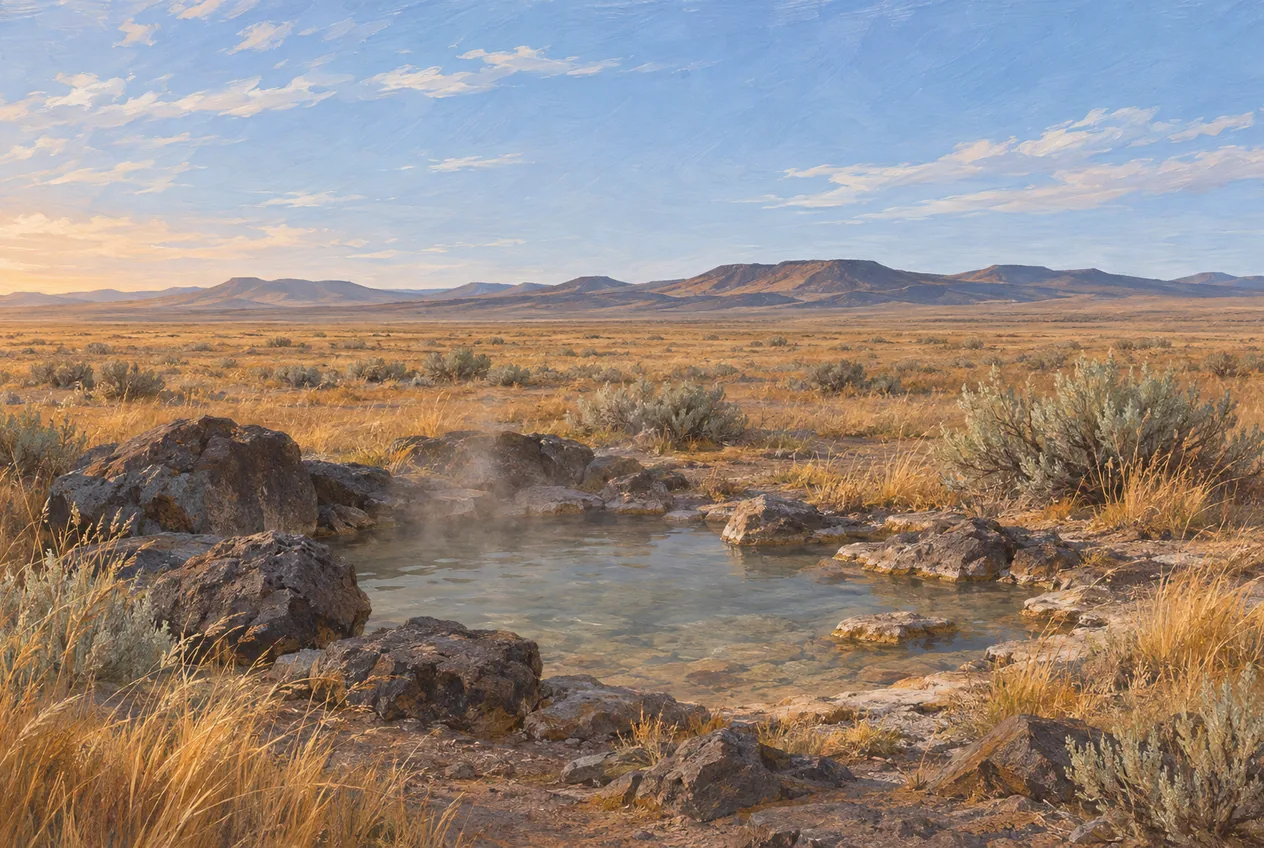
A quiet soak in the high desert can be the perfect counterpoint to a day on the lava. Wild Rose Hot Springs — also called Milford Sweat, Milford Hot Springs or Carey Hot Springs — is an undeveloped geothermal area near Carey, Idaho, along the route that links Carey, Craters of the Moon National Monument and Arco. People have historically visited this spring, but that does not guarantee access today. Check any current notices, obey signs, gates and landowner requests, and leave the place cleaner than you found it. The pools are near private land, so do not treat a map listing or past visitor report as a permanent right to enter. The second point that matters is the water: this is a primitive creekside soak, and no temperature you read online is a current measurement.
Jump to trip essentials- Region
- Carey, Idaho
- Season
- Any season; access and conditions vary
- Category
- Hot springs
Before you go
- Access has historically been a tolerated courtesy on or near private land — not a guaranteed public right. Obey all signs and gates.
- No facilities of any kind: carry water, pack out trash, and assume no cell coverage.
- Reported pool temperatures (upper 90s–100°F) are historical, not current — always test before entering.
- Use only a safe, legal turnout near mile markers 214–215; never block a gate or ranch access.
- Check Idaho 511 and NPS conditions in winter; spring and fall are the most comfortable seasons.
No public destination pin
Near the US-20/26/93 corridor, approximately 9–10 miles east of Carey, west of Craters of the Moon.
Wild Rose at a glance
Location: near US-20/26/93, approximately 9–10 miles east of Carey, Idaho. Other names: Milford Sweat, Milford Hot Springs, Carey Hot Springs. Setting: an undeveloped high-desert hot spring near Warm Springs Creek. Facilities: none. Access status: visitors have historically used the spring without a formal check-in, but access is not guaranteed; follow current signs, gates and landowner requests. Nearest communities: Carey to the west, Arco farther east. Nearby attraction: Craters of the Moon National Monument and Preserve.
And the rule that overrides all the others: if signs, gates or current conditions indicate that access is closed, do not enter. There is no way around a closure that a careful visitor should be looking for — a gate, a sign or a direct request from a property owner settles the matter.
Why one spring has five names
Search for this place and you will run into Wild Rose Hot Springs, Wild Rose Natural Hot Spring, Milford Sweat Hot Spring, Milford Hot Springs and Carey Hot Springs. They generally refer to the same undeveloped geothermal area east of Carey. “Wild Rose” is the name common in mapping and travel listings, while “Milford Sweat” reflects the family several guides describe as owning or historically allowing access to the land.
Knowing the alternate names is practical, not trivia: mapping applications, older articles and local references may all use different terminology, and it keeps you from confusing this roadside soak with the developed hot-spring resorts elsewhere in southern Idaho.
How to reach it from Arco or Carey
From Arco, travel southwest on US-20/26/93 toward Craters of the Moon and Carey, and continue past the national monument. The National Park Service places the Craters of the Moon visitor area 18 miles southwest of Arco and 24 miles northeast of Carey, which makes the monument a natural midpoint on this route — Wild Rose lies farther west, on the Carey side, so it suits a planned Carey–Craters–Arco outing far better than a quick detour from downtown Arco.
From Carey, follow US-20/26/93 east; published visitor guides place the commonly used access area approximately 9–10 miles outside Carey, near highway mile markers 214 and 215. The pools sit away from the immediate roadway and may be obscured by the terrain. Treat those details as approximate orientation, not an invitation to stop anywhere along the highway: use only a safe, legal turnout, keep the entire vehicle outside the traffic lane, and never block a gate, ranch access point or private road. Do not rely entirely on a dropped map pin — rural mapping data is imprecise, and a pin may mark the general spring area rather than a safe or authorised parking spot. Slow down only when it is safe, signal early, and if the normal turnout is full, blocked or unsafe, keep driving. Do not create a new parking area on vegetation or private property.
What to expect when you arrive
Wild Rose is a primitive natural soaking area, not a commercial spa. There are no reservations, attendants, changing rooms, showers, lifeguards, trash cans or maintained walkways, and no reliable restroom or potable water. Cell service is unreliable throughout the Craters of the Moon region — the NPS specifically advises downloading information for offline use because coverage within the park is very limited.
What you can expect instead: uneven volcanic ground, sharp or slippery rocks, mud and natural sediment, variable water depth, changing water temperatures, insects and wildlife, full exposure to sun, wind, snow or fast-changing weather, other visitors in a relatively small area, and no services of any kind.
Reports differ on the number, dimensions and exact temperatures of the pools, and that is normal for an unmanaged geothermal area: creek flow, spring output, weather, sediment and visitor modifications all change the soaking conditions. Some guides describe water in the upper 90s Fahrenheit, while other visits recorded around 100°F. Those are historical observations, not current measurements or safety guarantees. Always test the water yourself before entering.
What to bring (and what to leave home)
A short roadside approach can still present more risk than visitors expect, so bring enough equipment to manage the conditions without relying on anything at the site. Pack drinking water, sturdy shoes for the approach, water shoes for the pool area, a towel and a dry change of clothes, sun protection, warm layers in cooler months, a flashlight or headlamp, a first-aid kit, a trash bag, an offline map, and a vehicle emergency kit in winter.
Leave glass of any kind at home. Broken bottles in or around a natural pool are a serious injury hazard and are extremely difficult to remove completely; visitors have previously reported litter and broken glass around the soaking area, so check the ground carefully before walking barefoot. And if you are coming back to Arco for drinks, arrange the designated driver before you leave, not at the poolside.
Hot-spring safety, rule by rule
Test the temperature: check with a thermometer when possible, and at minimum test gradually with a hand or foot before entering. Pay particular attention to inflow points, where water can be considerably hotter than in the centre of the pool. Never assume a temperature posted online is still accurate — conditions shift with spring discharge, creek levels, weather and season.
Limit your soak: leave the water if you become dizzy, nauseated, unusually tired or overheated, and drink water before and after. Alcohol worsens dehydration and impairs judgement, so save drinks for after the driving is finished. Keep your head above water — untreated natural water may contain microorganisms; do not swallow it, keep open wounds out of the pool, and do not submerge your head. People who are pregnant or who have cardiovascular or blood-pressure conditions should get individualised medical advice before using very hot water.
Never soak alone: the area is undeveloped and cell coverage may be nil, so go with another capable adult, tell someone where you are going, and set a return time. Watch children closely — there are no lifeguards, barriers or standardised depths, and an adult should stay within immediate reach at all times.
Protect the spring — and continued access
The biggest threat to Wild Rose is not a lack of publicity. It is the cumulative effect of careless use. A natural spring can be closed quickly when visitors leave trash, use glass, damage fences, block ranch access, cut new roads or treat the surrounding land as a campground — and access that has been tolerated for years should never be read as an unconditional right. Public information about current access may be limited, so check for current notices and respect any posted restrictions or landowner instructions. If access is closed, do not enter. If it is open, pack out your own trash and pick up any litter you safely can.
So: pack out everything you bring, because there is no trash service, and consider picking up someone else’s litter too — leaving the area cleaner than you found it directly supports continued access. No soap or shampoo, even biodegradable products. Do not move rocks or reconstruct pools; altering channels changes water flow and damages the spring. Keep pets out of the pools. No glass, no fires. Do not camp unless you have confirmed camping is legal in a clearly designated area — the property boundaries here are not clear enough to assume it. No amplified music. Respect the privacy of other visitors. Obey every sign, gate and landowner instruction, and leave immediately if access is closed.
When to visit — every season has a catch
Spring and fall typically give the best balance of air temperature and soaking weather, but each season brings its own problem. In spring, snowmelt and runoff affect creek levels, approach conditions and water temperature, and mud makes the approach slippery. In summer, days on the Snake River Plain run extremely hot — the NPS notes summer temperatures at Craters of the Moon reach the 90s, while the black lava surfaces get far hotter — and afternoon winds are common; go early, carry more water than you think you need, and avoid long soaks in high ambient heat.
In fall the air is kinder for soaking, but daylight disappears fast — plan to be back at the vehicle before dark. In winter, snow and ice conceal roadside edges, rocks and uneven ground, and highway conditions change rapidly: check Idaho 511 and the current Craters of the Moon conditions page before leaving, and bring the vehicle emergency kit.
A sensible Carey–Craters–Arco day
Wild Rose fits naturally into a day on the volcanic landscape between Carey and Arco. A practical west-to-east run: start in Carey; visit Wild Rose only if legal access and conditions are clearly acceptable; continue east to Craters of the Moon; explore the visitor center, overlooks or open trails, checking seasonal road and cave conditions before committing to anything specific; finish the drive in Arco; park for the evening before stopping anywhere with drinks.
The park entrance is open year-round, but the seven-mile Loop Road generally operates from mid-April through late November as conditions allow, and visitor-center hours change seasonally. If a lava-tube cave is on the list, verify which caves are open — current NPS information says cave permits must be obtained in person during visitor-center hours. A closure of either still leaves plenty of aboveground lava scenery.
Be willing to skip it
Wild Rose can be a memorable stop, but only when the visit is legal, safe and low-impact. Check current property signs, weather, highway conditions and daylight before leaving; carry your own water and safety equipment; assume there are no facilities; keep glass, soap, loud music and vehicles away from the pool area; and pack out every piece of trash.
Most importantly: if access is closed, parking is unsafe, the pool is dirty or conditions are questionable, drive on to Craters of the Moon or Arco instead. The best visitors are not the ones who reach the water at any cost — they are the ones whose visit gives the property owner no reason to close it. Back in Arco with the driving done, Club Sawtooth at 156 W Grand Ave is the natural end to the day: cold drinks, darts and trip stories, after the keys are off the table.
Frequently asked questions
Where is Wild Rose Hot Springs in Idaho?
Near US-20/26/93, approximately 9–10 miles east of Carey, Idaho. Published guides generally place the access area near highway mile markers 214 and 215. It is west of Craters of the Moon, on the Carey side of the Carey–Craters–Arco corridor.
Is Wild Rose Hot Springs the same as Milford Sweat?
Yes. Wild Rose Hot Springs is also commonly known as Milford Sweat, Milford Hot Springs or Carey Hot Springs. Different maps and visitor guides use different names for the same general geothermal area.
Is Wild Rose Hot Springs open to the public?
Visitors have historically used the spring, but current access is not guaranteed. Check for current notices, obey signs, gates and property-owner requests, and turn back if closed. If you visit, clean up after yourself and leave the area better than you found it.
How hot is the water?
It varies by pool, season, creek flow and spring output. Previous visitors have reported temperatures from the upper 90s to around 100°F, but those measurements should not be treated as current. Always test the water yourself before entering, especially at the inflow points.
Are there bathrooms or water at Wild Rose?
No. Plan for an undeveloped location without restrooms, changing rooms, trash cans, potable water or emergency services. Carry everything you need and carry everything you bring back out.
Can you camp at Wild Rose Hot Springs?
Do not assume camping is allowed. Property boundaries and access rights are not sufficiently clear to recommend camping at the spring. Use a legal, established campground elsewhere and verify current availability before travelling.
Is Wild Rose near Craters of the Moon?
It is on the same highway corridor, on the Carey side of the monument. The NPS places Craters of the Moon 18 miles southwest of Arco and 24 miles northeast of Carey; Wild Rose is roughly 9–10 miles east of Carey, west of the monument.
What should I do after the soak and the drive?
Continue into Arco and stop at Club Sawtooth at 156 W Grand Ave, open daily 2pm–2am, for drinks, darts, pool, foosball and an AMI jukebox. Finish the driving first — never combine alcohol with a hot-spring soak or the dark rural drive back.
Sources and updates
Check current access, hours and conditions before setting out.